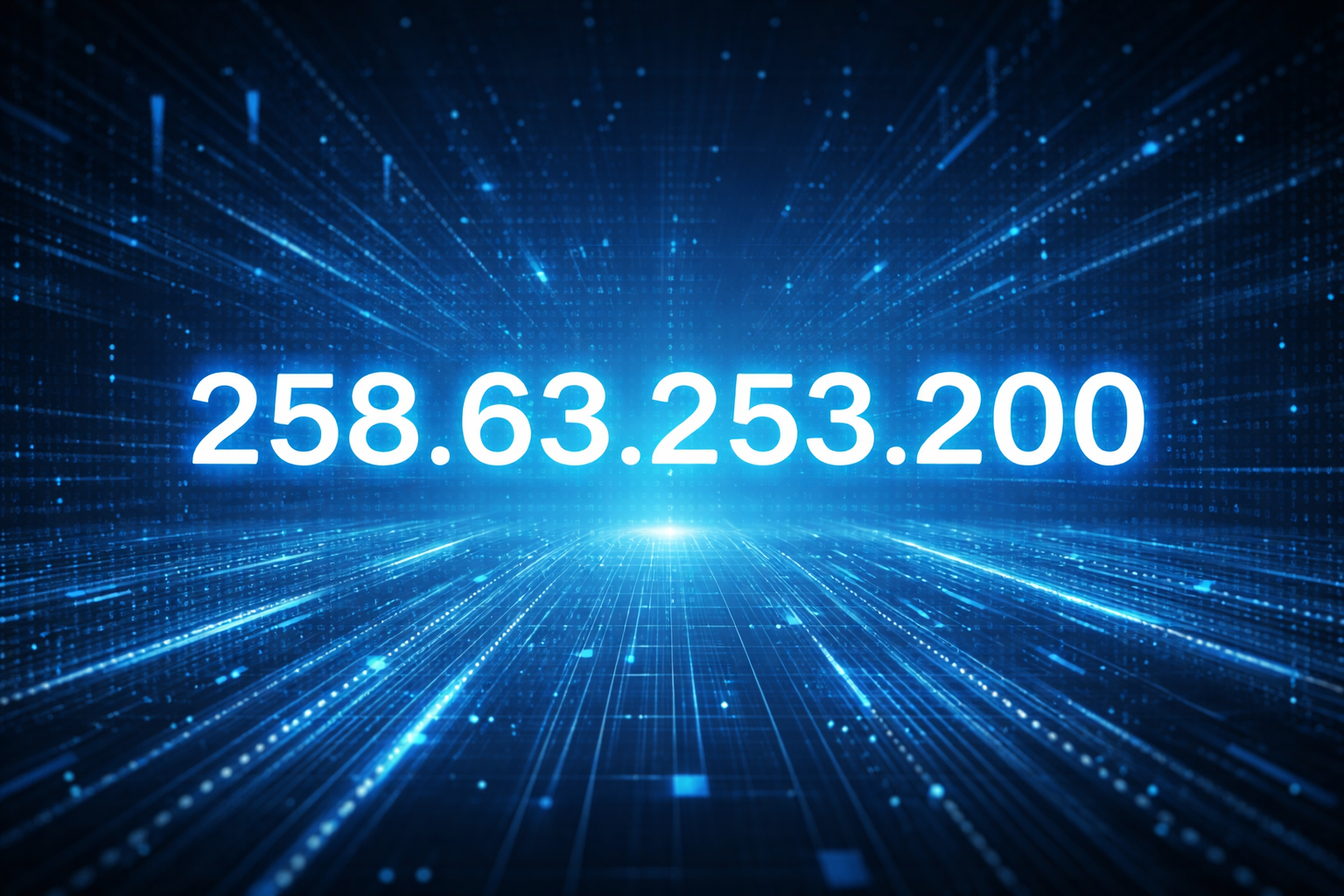
The string 258.63.253.200 appears at first glance to be an Internet Protocol address. Many readers encounter similar number-based identifiers in server logs, analytics tools, security alerts, or website dashboards. This article explains what such an address represents how it fits into the wider idea of internet addressing, and why understanding it matters for website owners, developers, ers, and everyday internet users. The discussion is informational and neutral with no promotional intent.
- What an Internet Protocol Address Is.
- Examining the Structure of 258.63.253.200
- Why Invalid Addresses Still Appear
- Use in Documentation and Examples
- Implications for Website Owners
- Role in Cybersecurity Discussions
- Comparison With Valid Addressing
- Transition Toward New Addressing Systems
- Educational Value of the Example
- Common Misunderstandings
- Practical Takeaways
- Broader Context in Digital Literacy
- FAQs
- Consolation
What an Internet Protocol Address Is.
An IP address is a numeric label assigned to devices connected to a network that uses the Internet Protocol for communication. Its main purpose is identification and location addressing. When a device sends or receives data, the address helps ensure the information reaches the correct destination.
Most commonly, people see version four addresses, which consist of four numbers separated by dots. Each number normally ranges from zero to two hundred fifty-five. This structure allows billions of unique combinations and has supported the growth of the internet for decades.
Examining the Structure of 258.63.253.200
At a glance, 258.63.253.200 appears to follow the familiar four-part pattern. However, a closer look reveals something important. In the standard version four, addressing each segment must be within a specific numeric range. The first segment here is two hundred fifty eight which exceeds the allowed maximum.
Because of this, 258.63.253.200 is not a valid public Internet Protocol version four address. It cannot be assigned to a device in normal network operations. When such a value appears, it is usually a placeholder, a formatting error, or a fictional example used for explanation or testing.
Why Invalid Addresses Still Appear
Invalid addresses show up more often than people expect. There are several common reasons for this.
One reason is data entry mistakes. A single extra digit can turn a valid address into an invalid one. Another reason is automated systems that log incomplete or corrupted data. In some cases, developers intentionally use impossible addresses in documentation to avoid pointing to a real system.
Security tools may also display malformed addresses when scanning detects unusual traffic patterns. Rather than representing a real source, the value signals that something about the data was not standard.
Use in Documentation and Examples
Writers and educators often need examples that will never accidentally route traffic to a real organization. Using an address like 258.63.253.200 avoids any chance of misdirection. It serves as a clear illustration without risk.
In training materials, such examples help learners focus on structure rather than on real-world consequences. Seeing an obviously incorrect number encourages readers to check validity rules and understand why limits exist.
Implications for Website Owners
For website owners reviewing access logs, an entry showing 258.63.253.200 should raise curiosity but not panic. Since it cannot represent a real visitor, it usually points to a logging anomaly. This could stem from a proxy misconfiguration or a parsing issue in analytics software.
The practical response is to verify logging tools and ensure data is being recorded accurately. There is rarely a security threat directly tied to an impossible address, though repeated anomalies could justify a deeper audit.
Role in Cybersecurity Discussions
In cybersecurity conversations, addresses like 258.63.253.200 often appear as examples of spoofed or malformed input. Attackers sometimes send unusual values to test how systems handle errors. A robust system should recognize the address as invalid and discard it safely.
Using fictional addresses in security training helps teams practice response procedures without exposing real infrastructure details. It reinforces the importance of validation and input checking.
Comparison With Valid Addressing
Understanding why 258.63.253.200 is invalid helps clarify how valid addressing works. Each segment in a version four address is stored in eight bits. Eight bits can represent values from zero to two hundred fifty-five. Any number beyond that cannot be encoded within the defined structure.
This mathematical limit ensures consistency across devices worldwide. When all systems follow the same rules, data can travel reliably across vast networks.
Transition Toward New Addressing Systems
The appearance of invalid version four examples also highlights the limitations of the older system. As the internet grew, the available pool of valid addresses shrank. This led to the development of a newer version with a much larger address space.
While the newer system uses a different format, the lessons remain the same. Clear structure, strict limits, and proper validation are essential for stable networking.
Educational Value of the Example
From an educational perspective, 258.63.253.200 is useful precisely because it breaks the rules. Students learning networking concepts can be asked to identify what is wrong with it. This encourages critical thinking rather than rote memorization.
Teachers often prefer such examples since they provoke discussion and reinforce understanding of numerical boundaries and protocol design.
Common Misunderstandings
Some people assume that any four numbers separated by dots must represent a real address. This misconception can lead to confusion when encountering values like 258.63.253.200. Recognizing the constraints prevents misinterpretation.
Another misunderstanding is believing that an invalid address automatically signals malicious intent. In reality, most occurrences are harmless artifacts of data handling or documentation.
Practical Takeaways
For professionals working with network logs or analytics, the key takeaway is awareness. Knowing the rules of addressing allows quick identification of anomalies. Rather than wasting time investigating a nonexistent source, one can focus on real, actionable data.
For general users, the example underscores how structured and rule-based the internet really is. Even something as simple as a number string follows precise technical standards.
Broader Context in Digital Literacy
Digital literacy includes understanding how identifiers work and what their limits are. Addresses like 258.63.253.200 provide an opportunity to learn about validation error handling and system design.
As more people engage with technology beyond basic use, such knowledge becomes increasingly valuable. It helps demystify the infrastructure that supports everyday online activities.
FAQs
Is 258.63.253.200 a real internet address?
No, it is not a valid version four Internet Protocol address because one of its segments exceeds the allowed numeric range.
Why might I see this address in logs or reports?
It usually appears due to data entry errors, software glitches, or as a placeholder example in documentation.
Does seeing this address indicate a security issue?
Not by itself. Most of the time, it represents malformed data rather than an actual threat.
Can a device ever use this address?
No standard-compliant network device can be assigned this value.
Why do educators use such examples? They help illustrate rules and boundaries without pointing to real systems.
Consolation
The identifier 258.63.253.200 serves as a reminder that the internet relies on strict technical rules even when values look simple. While it resembles a familiar address format, it breaks an essential constraint and therefore cannot exist in real network operations. Understanding why this matters improves digital awareness for developers, administrators, and everyday users alike. By recognizing valid structures and spotting anomalies, one gains clearer insight into how the digital world stays organized, reliable, and secure.